
Most homes with solar already have a good spot for a battery, usually a garage wall or a shady outside wall. The rules on where a battery can go come from the Australian battery safety standard, AS/NZS 5139. This guide explains them in plain English, so you know what to expect before we visit. Our licensed installer always confirms the final spot before any work starts.
The short version
- Outside the living areas. A garage or an outside wall. Never a bedroom, lounge, kitchen or study.
- Clear of openings. Keep about 600 mm, roughly the depth of a kitchen bench, from doors, windows and appliances.
- Safe and protected. A solid wall, out of strong sun, and safe from cars.
Where can the battery go?
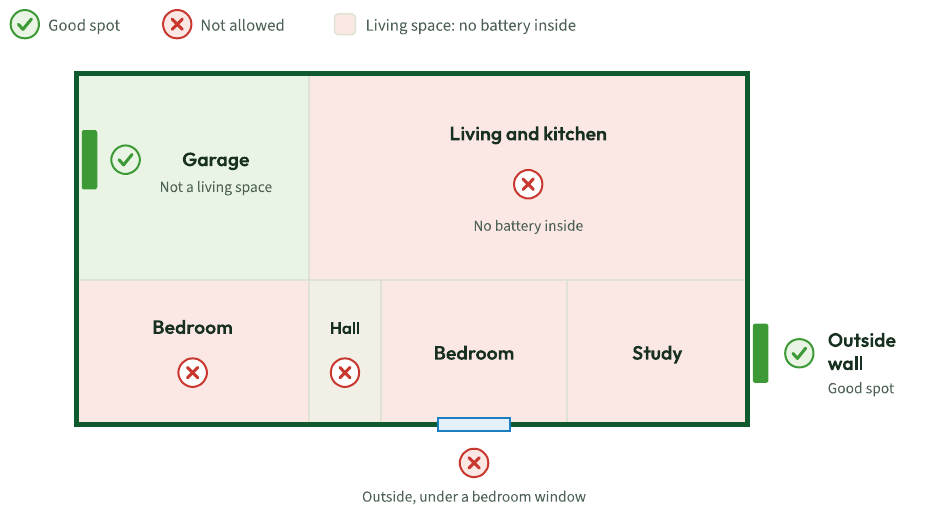
Usually a good spot:
- A garage wall, if the garage is not used as a living space
- An outside wall, ideally shaded or under the eaves
- A carport or side wall, with room to walk past
- Next to your switchboard or solar inverter
- A shed. A longer cable run may cost more.
Not allowed:
- Bedrooms, lounge, kitchen, dining room, study or playroom
- The roof or ceiling space
- Inside a wall cavity, or on the roof
- Under stairs or under access walkways
- A hallway or path that is an escape route
A garage turned into a bedroom, rumpus room or home office counts as a living space, so the battery cannot go inside it.
How much space does it need?
Picture an invisible no-go zone around every door, window and appliance: 600 mm to each side and 900 mm underneath. The battery must sit outside those zones.
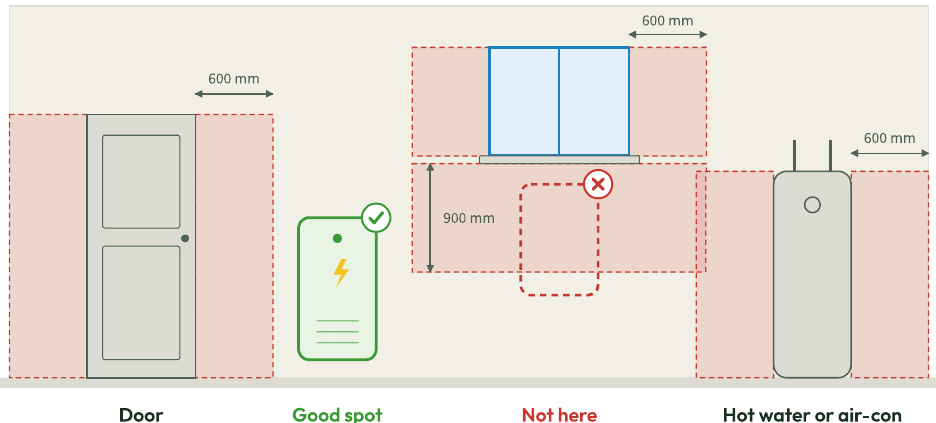
- Doors you use to get out: at least 600 mm from the side of a normal door (900 mm wide or less).
- Wide openings, such as a garage roller door: the battery can sit closer, if a clear 1 m walking space is kept in front of it and beside it. Our installer checks this on site.
- Windows and vents into a living space: at least 600 mm from the side, and not within 900 mm below.
- Appliances: at least 600 mm from a hot water unit, air-conditioner, EV charger or any other appliance that is not part of the battery system.
- Fine right next to the battery: your switchboard, the solar or battery inverter, power points and lights.
What else we check at your home
- The wall behind. If a living space is on the other side of a timber or plasterboard wall, a fire-resistant sheet goes behind the battery. It extends 600 mm past each side and 900 mm above. Brick, block, concrete, cement sheet and tiled walls already meet this rule.
- Strength. Larger batteries are heavy and need a solid wall, or a level concrete floor or pad.
- Sun and heat. Shade is best. Strong afternoon sun makes a battery run hotter, which can reduce its output and its life.
- Water. Not where rain pools or the ground floods.
- Cars. If a car could hit the battery (in a garage, carport or driveway), it needs protection such as bollards.
- Distance to the switchboard. The further away the battery is, the longer and more costly the cabling.
- Internet. The battery needs Wi-Fi or a data cable for monitoring, updates and warranty support.
Will I need any extras?
Every home is different, so some jobs need extra parts. Anything your home needs is listed on your quote before you sign.
| Item | When it is needed | Why |
|---|---|---|
| Battery-ready inverter | Your current solar inverter cannot connect to a battery | Lets the battery charge from your solar and power your home |
| Energy meter | Almost every install | Tells the battery how much power your home is using |
| Blackout backup | You want power during a blackout | Keeps chosen circuits running when the grid is down |
| Switchboard upgrade | Old fuses, a full board, or no room for new safety switches | Makes room for new breakers and keeps the board compliant |
| Fire-resistant wall sheet | A timber or plasterboard wall with a living space behind | Required by the safety standard |
| Bollards | A car could hit the battery | Protects the battery from impact |
| Floor stand or concrete pad | A floor-standing battery, or a wall that cannot take the weight | Holds the battery level and secure |
| Sun or weather cover | An exposed wall in strong sun or rain | Keeps the battery cooler and drier |
| Extra cable and conduit | The battery is far from the switchboard | Connects the battery safely |
| Wi-Fi extender or data cable | Weak Wi-Fi at the battery spot | Keeps monitoring and warranty support working |
Safety signs and the battery’s safety data sheet are included on every install.
Get an accurate quote, faster
Send us these photos and we can tell you the likely battery spot, and any extras, before we visit:
- Your switchboard, with the door open and closed
- Your solar inverter, and the label on its side
- The wall you would like to use, taken from a few steps back so nearby doors, windows and appliances show
- What is on the other side of that wall
- The path between the switchboard and that wall
- A recent electricity bill
Get your battery price online, or email the photos to sales@northwestenergy.com.au.
This is a general guide based on AS/NZS 5139:2019 (including Amendment 1) and Solar Victoria’s battery installation guidance. Battery brands can have extra requirements. The final location is confirmed by our licensed installer. Current at October 2026.
Northwest Energy Solutions installs solar, batteries and EV chargers across Victoria. northwestenergy.com.au